Why I built Mango: the ROI of my own freelance business dashboard
I built Mango, my own freelance business dashboard, because three client engagements were producing plenty of hours in Clockify and zero answers: what did this week actually earn, am I on pace for the month, and is the unpaid product work worth its mornings. Fourteen weeks after the first commit, I run my business through this dashboard, and this post shows the measured return: real figures, real screenshots, and the parts it has not fixed yet.
The problem: a freelance business dashboard nobody sold me
My week splits across three clients: a data-annotation platform billed hourly, an e-commerce engineering engagement billed hourly, and a brand consultancy on a weekly retainer. Under those sits my own agency's product work: unpaid now, paid later, if I pick well. Clockify held the raw truth about all of it and answered none of the questions that matter on a Friday.
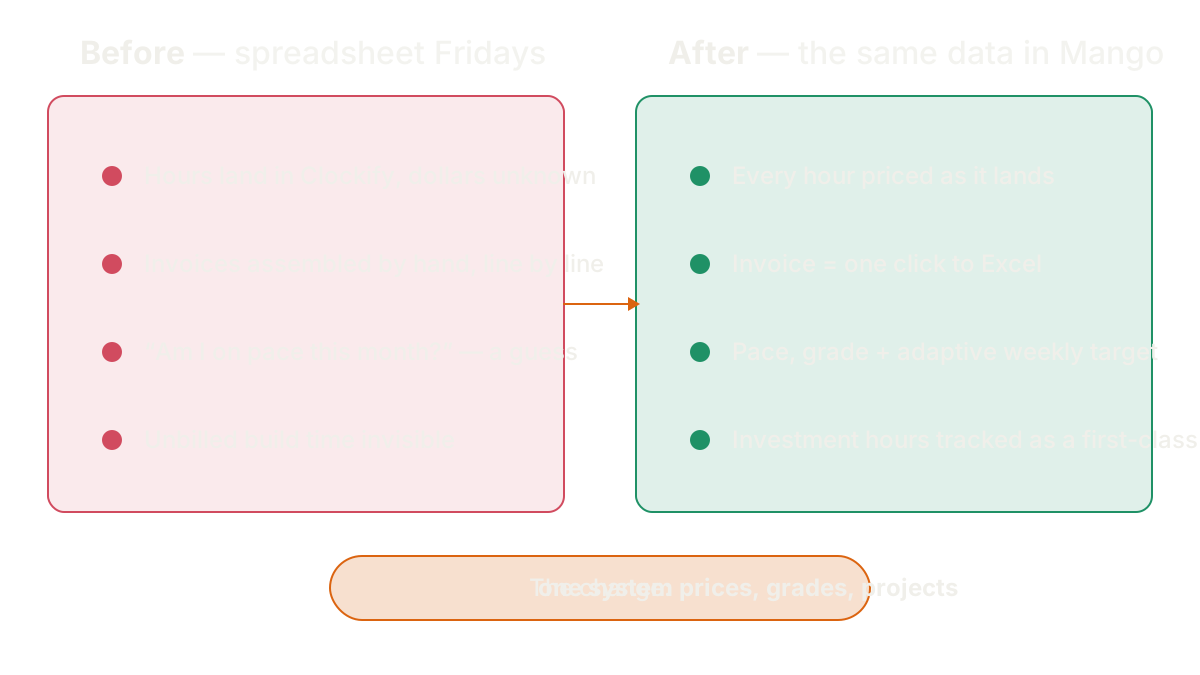
- Hours existed, but dollars did not: rates lived in my head and a spreadsheet.
- Invoices were assembled by hand from exports, line by line.
- "Am I on pace this month?" was a feeling, not a number.
- Unbilled build time was invisible, so it always lost to billable work.
The moment that tipped me into building: I realized my effective hourly rate was a number I computed quarterly, in a spreadsheet, after the decisions it should have driven. A rate you see once a quarter is trivia. A rate on screen every morning is a lever.
The journey: fourteen weeks, one dashboard at a time
Mango's repo was born April 3, 2026. The path from "income visible" to "the tool ships its own code" looked like this:
- April 3First commit. Flask app, Clockify ingest, a rate map. Every hour priced by dinner. A daily review with points and streaks followed the same week, because a mirror you don't open daily is a mirror that lies.
- April → MayRebuild on clean architecture. Four layers, sixty domain entities, JSON documents on S3 instead of a database. Boring on purpose: the money math is deterministic code, and the AI narrates instead of doing arithmetic.
- MayProjections and the AI advisor. Revenue run rate, scenario planning, and a strategy chat grounded in my actual entries rather than vibes.
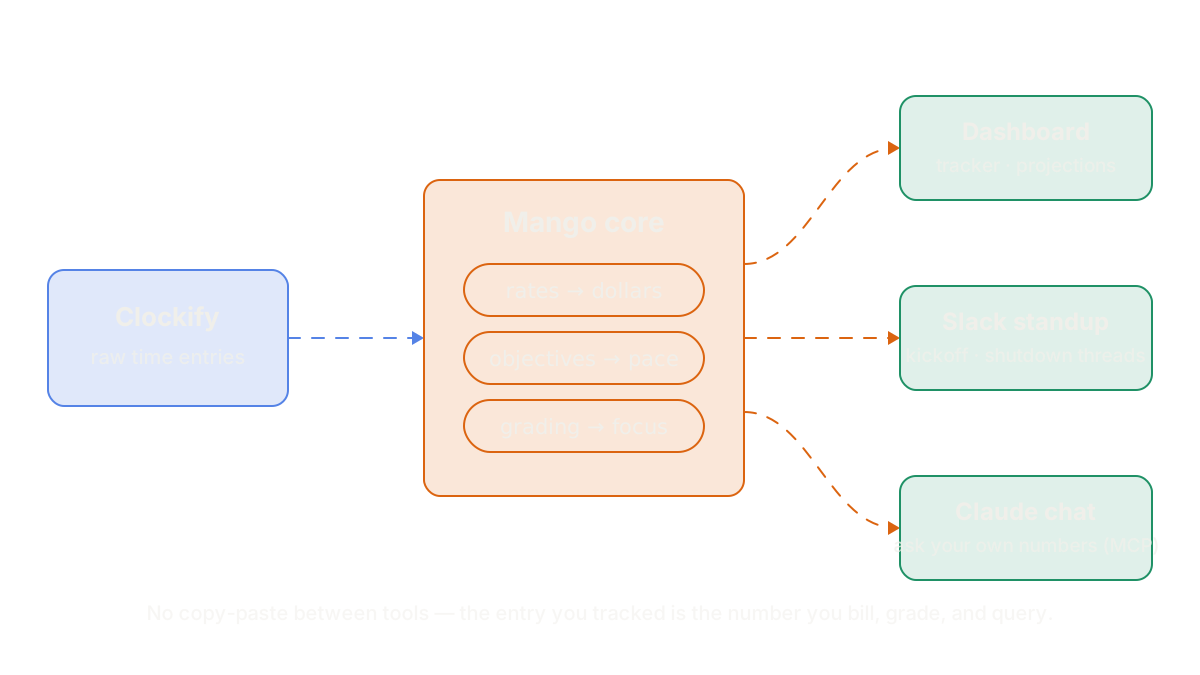
- May → JuneThe MCP connector. My own Claude chat can now answer "how many hours did I give the retainer this week?" from live data. Same numbers on laptop and server, one S3 bucket of truth.
- JuneSlack becomes the front door. A morning kickoff and evening shutdown thread open and close each day; I reply in plain English and the plan updates. The Code Kanban lands the same month: Mango starts shipping its own features as pull requests I review.
- JulyMulti-tenant private beta. Role-aware onboarding, client-approved shared reports, and a waitlist. The single-user tool becomes a product.
The ROI: what the numbers say three months in
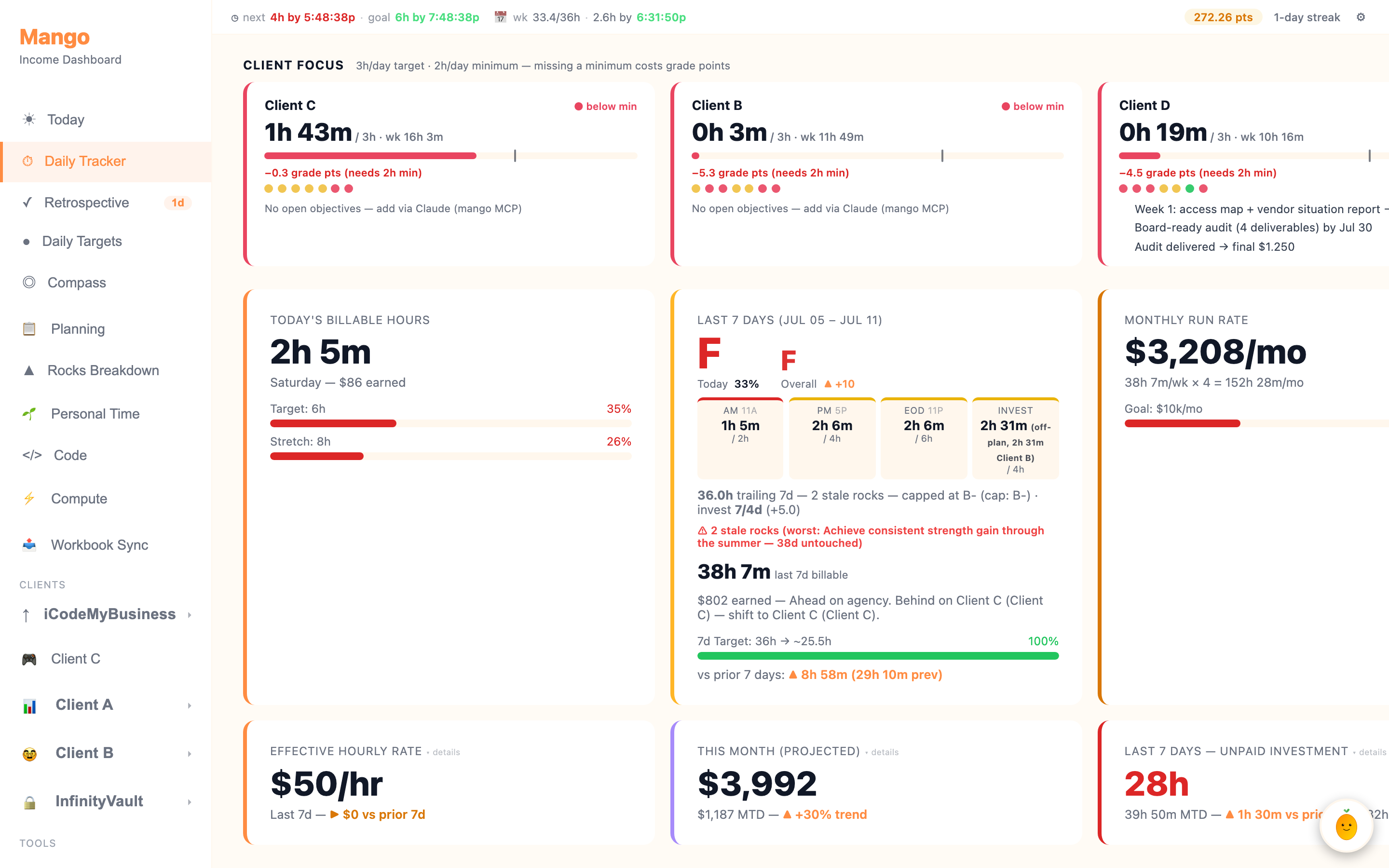
Here is the tracker on a real day (client names anonymized — the dollars are mine, the names aren't mine to publish):
1. Visibility changed behavior, and behavior is where the money is
The deepest return isn't a chart — it's time awareness. Tracking every working hour in Clockify, then seeing it priced and graded the same day, closed the gap between where I believed my time went and where it actually went. Each entry became a small spending decision: this hour either serves the plan or corrects it, and I now decline, defer, and batch work I used to absorb without noticing. That shift in decision-making deserves its own post, and it's the next one I'll write.
The numbers moved with the behavior. With the effective rate ($50/hr across paid lanes) and the pace gap on screen daily, the mix conversations stopped being annual. Last seven days of billable work: 38h 7m, up 8h 58m over the prior week after grading flipped to weight objectives over raw hours. And the target adapts the other way too: the week I ran ahead, the weekly target dropped from 36 to 30.6 hours. A dashboard that only says "more" burns you out; this one says "enough" when it's true.
2. It won revenue directly
The retainer engagement exists in part because Mango's proposal builder structured the tiered offer I pitched. That deal runs at $1,500 per week. One closed proposal paid for the build many times over, measured against the roughly 48 tracked hours it cost me.
3. Overhead came back as hours
Invoices went from an hour of Friday assembly to one click into Excel. Weekly client updates are drafted from tracked work and wait for my approval instead of my authorship. The morning plan writes itself into Slack. My estimate — and this one is an estimate, not a tracked figure — is 3–4 hours a week returned to billable or build time.
4. The build itself was the cheapest part
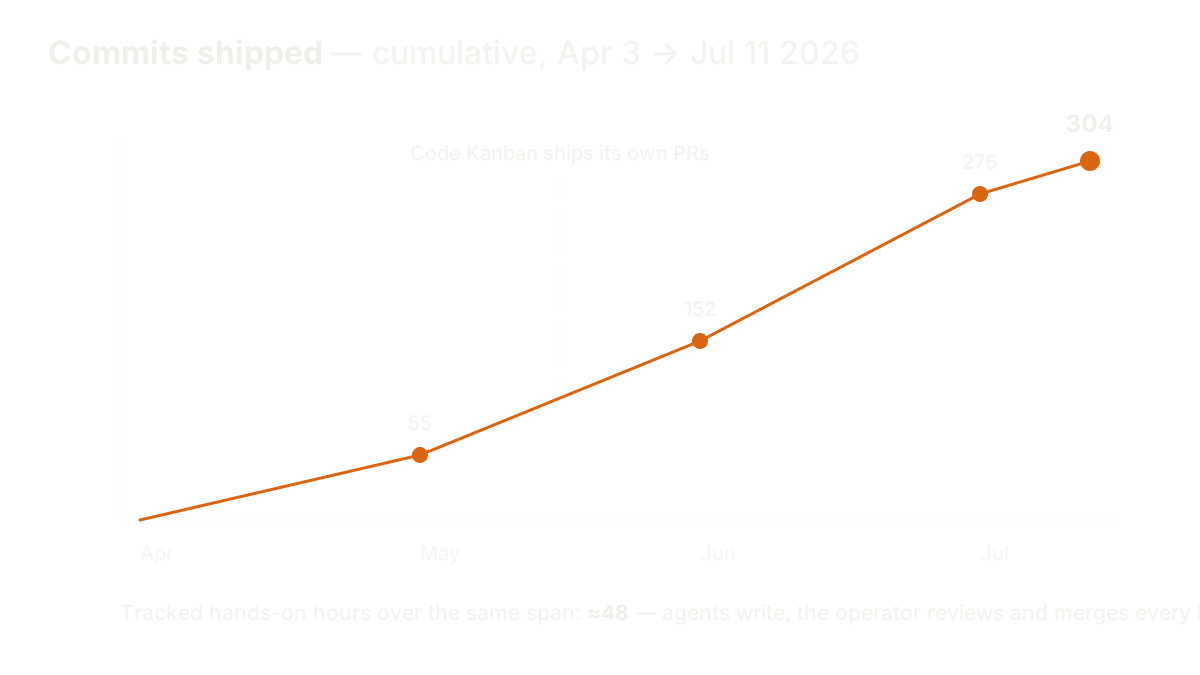
Fourteen weeks produced 304 commits, roughly 90,000 lines of Python, and 369 test files on about 48 tracked hands-on hours, because coding agents write the code and I review it. Mango's own Code board attributes AI cost per task; total direct API spend attributed there so far is $1.51. Recurring cost is one small VPS, S3 storage measured in pennies, and tokens measured in cents.
What it has not fixed
A results post you can trust needs the other column.
- The mirror is blunt. On a slow Saturday the grade is an F, and the F is correct. That's the point, and some days I hate it.
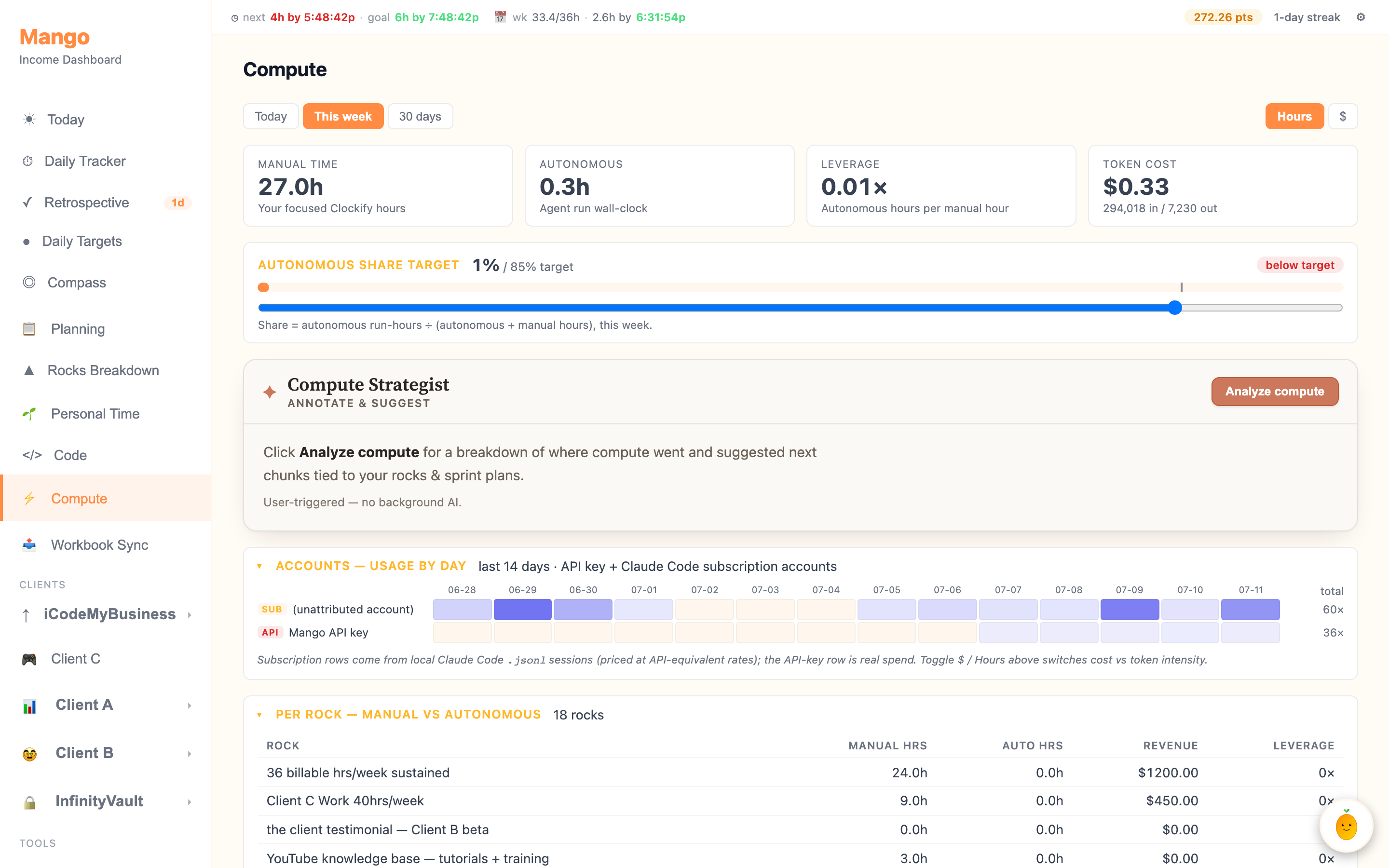
- Autonomy is early. Agents ship features, but autonomous run-hours are 1% of my total against an 85% ambition. Most work is still my hands on a keyboard.
- The revenue gap is now impossible to ignore. Hourly lanes alone run at about $3.2k/month against a $10k goal. The retainer and product lanes exist because that gap stares at me every morning. The dashboard names the problem; it doesn't close it.
The honest summary: Mango's ROI so far is one closed retainer, a week that gained nearly nine billable hours, a few hours of overhead back every week, and a codebase that builds itself for cents — in exchange for about 48 tracked hours and a daily grade that refuses to be polite.
What's next
Mango is becoming multi-tenant: role-aware onboarding, per-client authorized reports, and connectors so other contractors can point it at their own Clockify and Slack. The operating principles stay fixed: nothing client-facing sends without approval, money math stays deterministic, and I merge every line — more on that on the about page.
Mango is in private beta. Apply from the home page — chat with the discovery agent or drop your email on the waitlist.
Join the waitlistFAQ
Can I use Mango for my own freelance business?
Mango is in private beta and onboards a few contractors at a time. You can apply from the home page by chatting with the discovery agent or leaving your email on the waitlist. Clients of Mango contractors never need a seat; they join through their contractor's invite link.
What is Mango built with?
Mango is a Flask application with vanilla JavaScript on the front end and JSON documents on S3 instead of a SQL database. AI features run through Claude, and an MCP connector lets me query my own business data from a Claude chat. New features are written by coding agents as pull requests through a kanban board the app hosts itself.
How much does the AI cost to run?
Token spend this week was $0.33 for about 294,000 input and 7,200 output tokens. AI runs on explicit actions plus a small daily standup, with server-first routing and caching, so the recurring AI bill stays at pocket change. The infrastructure is one small VPS plus S3 storage that costs pennies per month.
Did AI really write most of the code?
Yes. Roughly 48 tracked hands-on hours produced 304 commits and about 90,000 lines of Python in fourteen weeks, because coding agents write the code and I review it. Nothing merges without a human: I read every pull request before it lands.
Building your own freelance business dashboard is a real option in 2026 — agents collapsed the build cost, and the numbers above are what mine returned. If you'd rather borrow this one, the waitlist is open.
Figures as of July 11, 2026, pulled from my own Mango tracker. Screenshots anonymize client names. Estimates are labeled as estimates.